Understand the difference. Choose the right solution. Stay compliant
Credit card processing doesn’t have to mean absorbing the entire cost of accepting credit cards. Two common strategies, dual pricing and surcharging, can help businesses offset some or all of their credit card acceptance costs. However, they work differently and are subject to specific card-brand, state, and disclosure requirements.
Empire Pays offers both compliant surcharging and dual pricing solutions, giving businesses the flexibility to choose the approach that best fits their business model and customers. We help you understand the differences, implement the appropriate program, and navigate the applicable requirements so you can offset processing costs while maintaining a clear and compliant payment experience.

A higher card price is established, with a lower cash price available.
Best for: Businesses that want to offer a lower price to customers who pay with cash.
VS.
A surcharge is added to the regular price when a customer pays with an eligible credit card.
Best for: Businesses that want to recover eligible credit card acceptance costs without changing their advertised prices.
Not sure which pricing program is right for your business? Here’s a simple comparison of Dual Pricing/Cash Discount and Surcharging.
How It Works
Customers are shown a credit price and a lower cash price. Customers who pay with cash receive the lower cash price.
Pricing Display
Both prices may be displayed. If only one price is displayed, it must be the higher credit price, not the cash price.
Customer Experience
Customers see the applicable price before completing the transaction.
Credit Cards
Customer pays the higher credit price.
Debit Cards
Debit transactions are processed at the credit price. The cash price is not applied to debit card transactions.
Cash Transactions
Customers paying with cash receive the lower cash price.
Receipt Requirements
The receipt must clearly identify the price paid by the customer based on the payment method. When a customer pays with cash, the receipt should reflect the lower cash price. When a customer pays by card, the receipt should reflect the higher card price.
How It Works
A surcharge is added to the regular price when a customer pays with a credit card.
Prices Displayed
The regular price remains the advertised price. The applicable surcharge is disclosed before payment.
Customer Experience
Customers are informed that a surcharge applies before completing a credit card transaction.
Credit Cards
The customer pays the regular price plus the applicable surcharge.
Debit Cards
Debit cards cannot be surcharged.
Required Disclosures
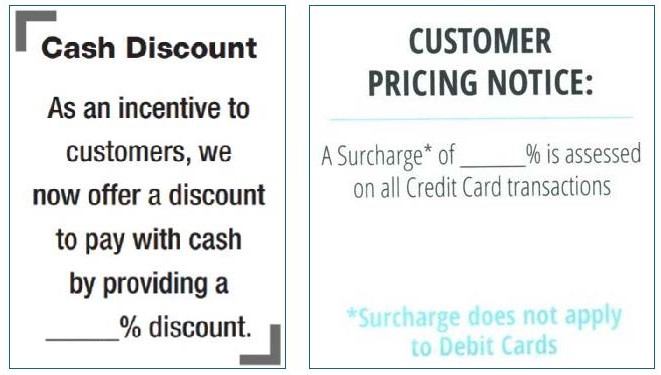
Required surcharge signage must be clearly displayed at the point of entry and at the point of sale, informing customers that a surcharge applies to credit card transactions. All required disclosures must comply with applicable card-brand and state requirements.
Surcharge Limit
Visa permits a maximum surcharge of 3%, while Mastercard permits a maximum of 4%. Empire Pays’ surcharge program is limited to 3% for all eligible credit card transactions, regardless of the card brand. This keeps our program consistent across all credit card transactions while remaining within the applicable card-brand limits.
Receipts
The surcharge must be clearly identified as a separate line item on the customer’s receipt. The receipt should show the original transaction amount, the surcharge amount, and the total amount paid. With Empire Pays, the surcharge reflected on the receipt will be limited to 3% for eligible credit card transactions.
| Dual Pricing/Cash Discount | Surcharging | |
|---|---|---|
|
How it Works |
Displays a higher card price and a lower cash price, with a maximum 4% markup on the card price. |
Adds a surcharge of up to 3% to credit card transactions |
|
Advertised Price |
Both prices may be displayed; if only one is displayed, it must be the higher card price. |
Regular price remains the advertised price; surcharge is added for credit card payments. |
|
Customer Sees |
Sees the applicable card price, with a lower cash price available as a discount. |
Sees the regular price at checkout; the surcharge is itemized on the receipt. |
|
Credit Cards |
Customer pays the higher card price. |
Customer pays the regular price plus the surcharge. |
|
Debit Cards |
Debit transactions are processed at the card price. The cash price is not applied to debit card transactions. |
Debit cards cannot be surcharged. |
|
Disclosure |
Customers must be clearly informed of the card price and available cash discount before payment. |
Customers must be clearly informed that a surcharge applies to credit card transactions, including the surcharge amount. |
|
Compliance |
Must comply with applicable card-brand, state, and program requirements. |
Must comply with card-brand and applicable state/federal requirements. |
Not sure which pricing program is right for your business? Here’s a simple comparison of Dual Pricing/Cash Discount and Surcharging.
HOW IT WORKS: Customers are shown a credit price and a lower cash price. Customers who pay with cash receive the lower cash price.
PRICING DISPLAY: Both prices may be displayed. If only one price is displayed, it must be the higher credit price, not the cash price.
CUSTOMER EXPERIENCE: Customers see the applicable price before completing the transaction.
CREDIT CARDS: Customer pays the higher credit price.
DEBIT CARDS: Debit transactions are processed at the credit price. The cash price is not applied to debit card transactions.
CASH TRANSACTIONS: Customers paying with cash receive the lower cash price.
RECEIPT REQUIREMENTS: The receipt must clearly identify the price paid by the customer based on the payment method. When a customer pays with cash, the receipt should reflect the lower cash price. When a customer pays by card, the receipt should reflect the higher card price.
HOW IT WORKS: A surcharge is added to the regular price when a customer pays with a credit card.
PRICES DISPLAYED: The regular price remains the advertised price. The applicable surcharge is disclosed before payment.
CUSTOMER EXPERIENCE: Customers are informed that a surcharge applies before completing a credit card transaction.
CREDIT CARDS: The customer pays the regular price plus the applicable surcharge.
DEBIT CARDS: Debit cards cannot be surcharged.
REQUIRED DISCLOSURES: Required surcharge signage must be clearly displayed at the point of entry and at the point of sale, informing customers that a surcharge applies to credit card transactions. All required disclosures must comply with applicable card-brand and state requirements.
SURCHARGE LIMIT: Visa permits a maximum surcharge of 3%, while Mastercard permits a maximum of 4%. Empire Pays’ surcharge program is limited to 3% for all eligible credit card transactions, regardless of the card brand. This keeps our program consistent across all credit card transactions while remaining within the applicable card-brand limits.
RECEIPTS: The surcharge must be clearly identified as a separate line item on the customer’s receipt. The receipt should show the original transaction amount, the surcharge amount, and the total amount paid. With Empire Pays, the surcharge reflected on the receipt will be limited to 3% for eligible credit card transactions.
DUAL PRICING: Merchants must clearly disclose the applicable card and cash pricing. In-store pricing may display the card price alone or both the card and cash prices. At the point of sale, both the card price and cash price must be clearly displayed before the customer selects their payment method.
SURCHARGING: Merchants must notify and register their intent to surcharge with the applicable processing/acquiring bank and follow all required card-brand procedures before beginning a surcharge program. Advance notice requirements may vary by card brand and processing arrangement.
DUAL PRICING: The receipt should clearly reflect the price actually paid by the customer based on the payment method used. The transaction should not be presented as a separate surcharge or service-charge fee.
SURCHARGING: The final surcharge amount, sometimes referred to as a Service Charge, must be itemized as a separate line item on the sales receipt. If an item is returned or a transaction is refunded, the applicable portion of the original surcharge must also be refunded to the cardholder.
SURCHARGING: Merchants must prominently display their surcharge policy, which Empire Pays will provide. The policy must not disparage the card brand, network, issuing bank, or payment card product being used.
Retail/Restaurant (card present) merchants must display the required surcharge disclosure at the point of entry and point of sale. Online merchants must disclose the surcharge policy wherever payment types are mentioned and on the checkout page.
Customers must have the opportunity to pay using another accepted payment method before the surcharge is applied.

 IMPORTANT: COMPLIANCE MATTERS
Failure to follow proper credit card surcharging regulations can expose businesses to significant penalties. Non-compliance may result in fines, termination of credit card processing privileges, or placement on the MATCH list (formerly TMF), which can make it difficult to obtain merchant services in the future.
Surcharge limits can vary by card brand. Visa permits a maximum surcharge of 3%, while Mastercard permits up to 4% under its applicable rules. However, Empire Pays’ surcharge program is limited to a maximum of 3% for all eligible credit card transactions.
Our approved surcharge technology automatically performs a BIN lookup to identify eligible credit card transactions and prevents the surcharge from being applied to debit or prepaid cards.
Card networks and acquiring banks have compliance procedures in place to identify potential violations and may review merchant transactions to verify that surcharge programs are being administered properly.
With Empire Pays, merchants receive the guidance, technology, signage, and ongoing support needed to implement a properly structured dual pricing or compliant surcharge program, helping businesses reduce or offset eligible credit card processing expenses while providing customers with clear and transparent pricing.